Critiquing a Critique

Mythcreants and Malazan

When I began expanding my experiences of reading in the genre of fantasy in 2023, joining groups on Reddit, discovering new authors and ending up with far too many recommendations; re-igniting my passion for literature and adding to my now ever-increasing “to be read” lists, it was inevitable that I would end up hearing about The Malazan Book of the Fallen.

Of course, I didn’t know that at the time, but when I joined a reading group on Discord, Malazan was mentioned, so I got a copy of the first book from my local Waterstones, with the intent of reading it along with the group when they started. I searched my Reddit group (r/fantasy) just to see what it was all about and get the gist of it etc, and discovered that a lot of potential readers were “put off” about reading the series because of its complexity and many had decided not to read the series at all, purely based on the negative experiences of others having not enjoyed the first in the series, or having not being able to “understand” the books.

I took a sneaky peek at my copy. I didn’t get why people didn’t get it. I started looking for reviews and reasons as to why readers had issues with the series. Google, as always, is my friend. I focused my search on book one of the series, Gardens of the Moon and one of the first articles I found was on a site called Mythcreants.

Here’s what their website says:

“Mythcreants is an online publication for speculative fiction storytellers. To better understand and tell the stories we love, we analyze popular works, theorize on storytelling craft, and explore the technical aspects of writing and tabletop roleplaying. We’re here to educate you on the most effective ways of engaging your audience while providing entertainment, insight, and inspiration.”

There are hundreds and hundreds of articles on this site. The one I found is titled: Lessons From the Extremely Serious Writing of Malazan.

I love literature. I love literary analysis. I love discovering what works, what doesn’t work, and why. I love nuance and inflection and imagery and poetry and insight. I also love learning about literature, so this article seemed right up my alley.

I read the article, looked at the comments, joined the Malazan group on Reddit (r/Malazan was mentioned in the comments) and did a search, found more comments about the article there, and then went back to the article. This article was posted on Mythcreants in June 2023. It is still receiving comments now, and I’m not at all surprised. I’m also not surprised that some comments were deleted at some point as I can see how things may have become quite heated – I can also understand why, and I’ll get to that later, but I digress.

The article focuses on the prologue of the first book of the Malazan series, Gardens of the Moon. It’s written by a member of Mythcreants team, Chris Winkle, who is the Founder and Editor in Chief.

This is my response to that article, both as a reader and as someone who has studied and is interested in literary analysis and criticism.

I want to clarify here, that I was not offended by the article. My intent here is not to be disrespectful in any way to Chris, or anyone who shares the opinions she has of Steven Erikson’s work. The article is presented as a teaching article, and is tagged as analysis, writing, dialogue, lessons from bad writing, scenes. My responses are intended to give an alternative view/alternative analysis of the text, supported by evidence. My aim is to give an honest and fair representation, both of Erikson’s writing, and the article in respect of how I interpret the content of each. In some cases, it may even be a critique of the critique.

The original article is quite long, and although most of the text is repeated in these posts to give context to Chris Winkle’s analysis and my own responses, you may want to give it a look first. You can find it here.

Quotes from the book are formatted as such. Responses from the writer of the article are cited as CW: and are italicised. My own responses follow and are not labelled or italicised so that it’s less confusing.

I’ve split my response into sections that follow the structure of the original article, and because the whole response would be long. They are linked below.

My closing comments are here

One Down, Twenty-Four to Go!

And boy am I glad I started small!


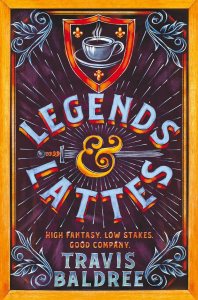
Legends & Lattes by Travis Baldree is a lovely light-hearted fantasy about new-beginnings, new friends and living your dreams. The premise is simple, the execution sublime, and the outcome totally expected but completely satisfying. The characters are loveable, likeable and more importantly, believable. The plot is good, well paced and satisfying – and not all questions are answered, but why shouldn’t there be a little mystery in this cosy fantasy? It was a quick read that I really enjoyed: it made me smile, it made me laugh and while I didn’t expect to like it, I really, really did and would quite happily recommend it to someone looking for some light, unique fantasy.

I’m so glad that I decided to take part in the Book Bingo, and that this was my first read for it. I don’t do a lot of fantasy beyond what I already know, so the idea of stepping out of my comfort zone with this one really was me doing exactly that. Legends & Lattes is Viv’s journey from being a bad-ass Orc Warrior, to wanting to settle down and, for want of a better word, “retire” to a peaceful life – the one she’s dreamed of. She’s discovered coffee on her adventures as a warrior, and fancies herself as a barista – bringing new tastes and delights to the city of Thune and while this sets out as a solo venture, Viv soon gains new friends (and staff) who eventually become family, and learns that although the path to living your dreams isn’t always easy, it’s always worth it.

I loved the light-heartedness of this story – I had no trouble at all getting into the narrative and that’s down to the author – it was easy to see what he was trying to achieve but it didn’t get in the way of my enjoyment of the plot. The pacing was perfect – there’s enough comfort to keep you satisified, and enough tension to keep the plot intriguing. Yes, there are tropes – found-family, beginning of a new romance, a villain from the past but none of these feel forced or contrived.

Would I have normally picked this book up and read it? No. I wouldn’t, and if I hadn’t I’d have missed a total gem of a book, so I’m really glad that I picked it up. Is it a literary masterpiece? No. Does it need to be? Again, no. Would I read it again? Yes.

Cawpile rating: 8.14/10 (equivalent to 4 stars)

Characters: 8/10
Atmosphere: 8/10
Writing: 9/10
Plot: 8/10
Intrigue: 7/10
Logic: 8/10
Enjoyment: 9/10

I’m always late to parties…

Apparently, you can always find me in the kitchen at them, too…

Reading, most likely. Or talking about reading. Or talking about books. Or something I’ve read about books. Or drinking. At parties, that is. Anyway, I digress. I am late to books, shows, movies, authors, and all of these wonderful other things that I didn’t even realise there were parties for – there is always another secret and all that – or, in my case, discovery. I can now add another item to my ‘eventually found it’ list – I have discovered reddit – more than that, I have discovered lots of groups on reddit that talk about the stuff I like to talk about. Like books, and shows and movies and authors.

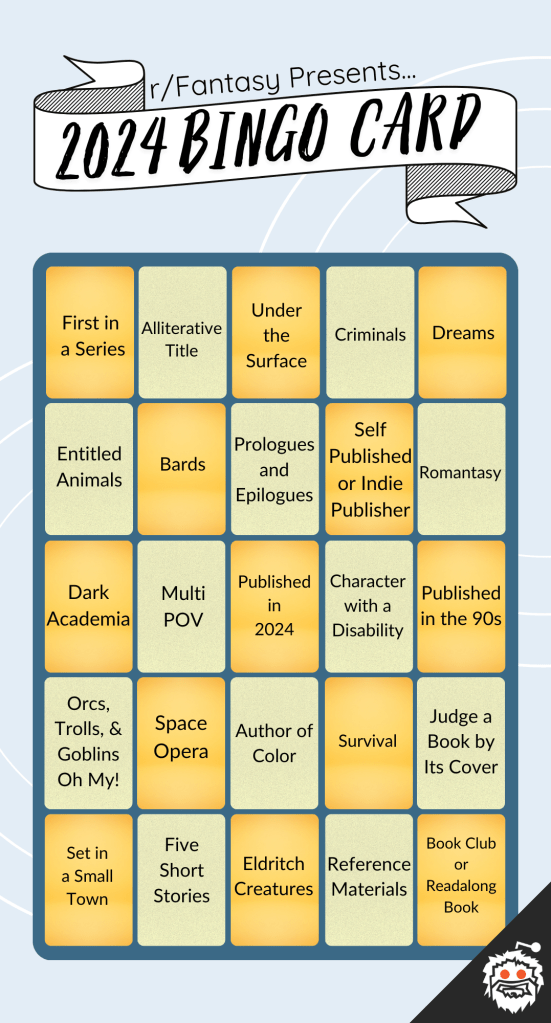
This latest discovery – the communities, or ‘subs’ of reddit – have proven to be a major distraction with plenty of temptations for driving my ‘to-be-read’ pile of books into the realms of more insanity than is already prevalent in my batshit-crazy-for-books lifestyle, and if that’s not exciting, I don’t know what is!! I found the r/fantasy sub and with that came plenty of recommendations, clubs, readalongs and another absolute gem – the Annual Book Bingo Challenge. The purpose of the book bingo, from what I can gather, is to take you out of your comfort zone, get you reading a wider range of authors and types of fantasy etc. I’m sure you get the idea.

Also, it is ridiculously challenging to actually try to plan for this thing! I trawled through the recs thread and came up with a couple of ideas, but I’ve also typed out the list of bingo square requirements and passed them on to the lovely people who work at my local Waterstones to see what they can come up with by way of ideas. They see me often enough to know if something is or is not in my comfort zone as well as whether I’ll take to something or not, so I figured I’d get their input and see what happens. I’m looking forward to seeing what they come up with. There are a couple of books that I have already made decisions about, but the rest will be completely random in terms of the choosing, because they are choosing for me as are the wonderful members of the r/fantasy sub that have recommended some marvellous sounding tales.

As an additional challenge, I’ve decided to journal/blog about this experience 1) because I think it will be really interesting and 2) because I’m totally bonkers! The link to the bingo is now on the bar at the top and I’ll be updating fairly regularly soon. My Malazan Journey is still ongoing, and the bingo will also give me little breaks (that are much needed) from the series. So yeah, back to the bingo…

25 books, 25 different authors, 25 different requirements. From April 1st 2024 to March 31st 2025.

It’s going to be GLORIOUS!!!

The Beginning of Rebellion

Poisoned Berries & the Benefits of Cliff-hangers

I’ll be the first to admit that The Hunger Games (THG) isn’t much of a ‘new’ read for most – if you’ve not read the books, you’ve probably seen the films. What can I say? I always manage to be late to the party, and it’s true here for both the books and the movies. Over the festive period of 2023, I stumbled across a marathon of THG on the gogglebox – now normally, I’d read books before watching any type of adaptation, but after about five minutes of watching, somewhere in the middle of Catching Fire, I got intrigued, and started from the beginning.

Yes, I binged watched. The entire thing. Twice.

Then I got to thinking (which is never a very good thing and usually results in me causing myself more work than necessary.) I knew I had the trilogy buried somewhere in my extremely disorganised bookshelves, so I went to find them. Four days and a whole room of semi-organised shelves later, I sat down and started the first book – and I have to say, I was pleasantly surprised.

There are elements of the book that add a depth that you simply don’t get by watching the movie first and it was those additional elements that kept me turning the pages. Katniss is thrown into a situation that she had deliberately tried to avoid, for both herself and her sister. This right here is the hook – in the movie, it’s honourable and brave – and it’s the same in the book, but add to that the explanation of how the drawing works and there’s a whole extra shock factor – Katniss’ has 20 entries into the draw for the games – because of the convoluted nature of the capitol and how it oppresses it’s people. Twenty. Accumulated over 4 years. Her sister has one, only because Katniss refused to allow her to increase that amount by using the Tesserae (an option to add your name into the draw for a meagre supply of food supplies) thereby limiting her chances of being chosen. So the fact that Prim’s name is called, and that Katniss volunteers is even more shocking because it illustrates, emphasises and reflects the hopelessness of the society in which she lives.

“There must have been some mistake. This can’t be happening. Prim was one slip of paper in thousands! Her chances of being chosen were so remote that I’d not even bothered to worry about her. Hadn’t I done everything? Taken the tesserae, refused to let her do the same? One slip. One slip in thousands. The odds had been entirely in hear favour. But it hadn’t mattered.”

Katniss already had to grow up too quickly – the care of her family becoming her responsibility when her mother suffered what can only be seen as a significant mental breakdown after the death of her husband. Everything she has ever done has been for Prim, and volunteering is no different – yet it is. The odds of her survival are not high, particularly when there are kids from other districts who are specifically trained to become tributes for the games. She knows that she is most likely going to die, and she handles it particularly well, considering the circumstances. I found her to be full of nervous energy, and a remarkable amount of anger – understandably so – but I also think that Katniss had spent so long looking after everyone else, that she’d lost her own identity, because of what she had to do and who she had to be in order to survive. Katniss has self-awareness, but low self-esteem. She’s described as sullen and hostile, which again I wasn’t surprised about, and it’s with Cinna (who I loved by the way, book and film both) who she finds the comfort to be herself.

But where Katniss shines the most is in the arena, because the Katniss in the arena is in survival mode, just like she’s been at home – except now it really is a matter of life or death. From that first moment where she ignores Haymitch’s advice and runs for the equipment shows her true nature – it’s not rebellion against authority, it’s simply who she is – she’s a fighter. She’s also skilled as a hunter, caring as an ally and vulnerable in her grief and ruminations about her emotions. That vulnerability, expected in any 16 year old girl, is what she cannot reconcile to herself, but it’s one of the most endearing traits she has. I like kick ass Katniss – the hunting, the running away from fireballs, the whole tracker-jacker scene and destroying the Career’s supply stash pyramid – it’s all very exciting and well-written. She is bad ass. But I love vulnerable Katniss: when she loves, it’s fierce.

“I’ve no idea where to go. The brief sense of home I had that one night with Rue has vanished. My feet wander this way and that until sunset. I’m not afraid, not even watchful. Which makes me an easy target. Except I’d kill anyone I met on sight. Without emotion or the slightest tremor in my hands. My hatred of the Capitol has not lessened my hatred of my competitors in the least. Especially the Careers. They, at least, can be made to pay for Rue’s death.”

But for all that, I feel like it sort of fell flat near the end… Letting Cato suffer during the ‘muttation’ attack (although it was extremely disconcerting that they shared features of the dead tributes – what on earth are the Capitol doing there? scary) felt out of place, and I preferred the way the film dealt with it, although it did serve to remind how the citizens viewed the games – prolonged suffering=more entertainment. I guess I just didn’t feel it was necessary. And the berries suicide scene was anti-climactic.

Then, Katniss simply slipped back into who she was before… and come the end of the final chapter (27 in my copy) we’re left with the remnants of a relationship, and some worries about the future. It kind of just, fizzled out…

So, I pretend that it ended in the previous chapter, and chapter 27 happens as a flashback/intro to Catching Fire, because this knife edge, this tension is how I think it should have ended. I’m not going to quote it all, but just these little sections really caught my eye. Plus I think ending on this kind of cliff-hanger is awesome.

“When I left the arena, when the trumpets played, I was supposed to be safe. From then on. For the rest of my life.”

There’s the hook.

Here’s the kicker.

“There are questions to be unravelled back home, in the peace and quiet of the woods, when no one is watching. Not here with every eye upon me. But I won’t have that luxury for who knows how long. And right now, the most dangerous part of the Hunger Games is about to begin.

Rating: 4/5 Stars